The Closing Ceremony of an Olympic Games is a bittersweet affair — a celebration of what was and an acknowledgment that the magic is ending. When Hilary Knight walked into the ceremony carrying the American flag alongside ice dancer Evan Bates, the bittersweet hit differently. This wasn't just the end of the 2026 Games. It was, almost certainly, the end of the most important career in American women's hockey history.
The Numbers
Let's start with the raw data, because it's staggering. Hilary Knight competed in five Olympic Games for Team USA: Vancouver 2010, Sochi 2014, PyeongChang 2018, Beijing 2022, and Milano Cortina 2026. She won four Olympic medals, including gold in Milano Cortina. She is the all-time leading scorer in U.S. Women's National Team history. She has more World Championship appearances than most athletes have international caps, period.
But numbers don't capture what Knight has meant to women's hockey. For that, you need context.
The Pioneer
When Knight made her first Olympic team in 2010, women's hockey was fighting for survival. Funding was precarious. Media coverage was an afterthought. The pay gap between men's and women's programs was a canyon. Knight, even as a 20-year-old, understood that playing well wasn't enough. She had to be an advocate, a spokesperson, and a business case for investment in women's hockey — all while competing at the highest level.
She did all of it. Knight was a central figure in the 2017 national team boycott, when the U.S. Women's National Team refused to participate in the World Championship until USA Hockey improved their compensation, benefits, and support. The boycott was a watershed moment — not just for hockey, but for women's sports in America. It succeeded. And Knight, with her combination of on-ice talent and off-ice leadership, was its face.
"We weren't asking for special treatment," Knight said at the time. "We were asking for fair treatment. There's a difference. And we weren't willing to accept anything less."
The Final Gold
Knight's last Olympics was her best. In Milano Cortina, playing alongside a new generation of stars like Coyne Schofield and Frankel, she was no longer the team's primary scorer. She didn't need to be. Her role had evolved into something more valuable: the heartbeat of the team. The player whose mere presence in the locker room elevated everyone around her. The veteran who could settle a room with a look, inspire a rally with a shift, and deliver a crucial goal when the moment demanded it.
And deliver she did. Knight's performance throughout the tournament was a masterclass in competitive intelligence. She picked her spots, creating space for younger teammates while remaining a constant threat whenever she touched the puck. In the gold medal game, she assisted on the go-ahead goal with a cross-ice pass of such precision that her teammate joked afterward, "I couldn't have missed that if I tried."
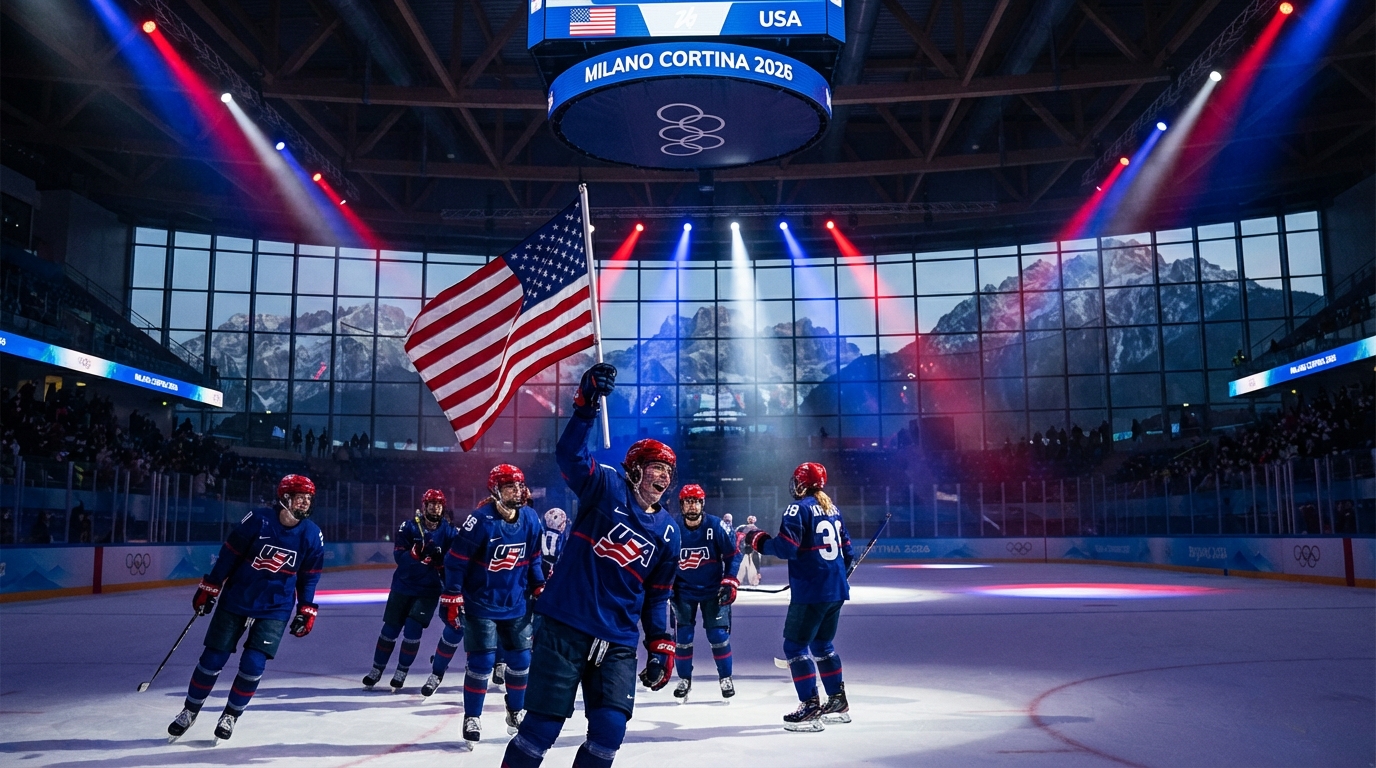
When the final horn sounded and the Americans celebrated their gold, Knight was at the center of the pile. Five Olympics. Four medals. One legend.
Carrying the Flag
The selection of Knight as a Closing Ceremony flag bearer was unanimous among Team USA's athletes. It was less an honor than a recognition — a collective acknowledgment that no single athlete had done more for American winter sports over the past sixteen years.
"When we voted, it wasn't even close," said one teammate. "Hilary is Team USA. She's been fighting for all of us — not just hockey players, all of us — since before most of this team was old enough to compete."
Knight shared flag-bearing duties with Evan Bates, the ice dancer who had won team gold and individual silver. The pairing was fitting: two athletes at the end of extraordinary careers, two competitors who had elevated their sports through excellence and advocacy, two Americans who understood that carrying the flag meant carrying the hopes and values of an entire delegation.
The Walk
The Closing Ceremony in Milano Cortina was held under a canopy of Italian stars, the Alpine air carrying the sounds of celebration across the valley. When Knight emerged with the flag, the American section of the crowd erupted. Her teammates surrounded her, chanting her name. Television cameras caught tears streaming down her face — the first time many had seen the famously composed Knight show that kind of emotion in public.
"I kept thinking about 2010," Knight said afterward. "I was 20 years old, just happy to be at the Olympics. Now I'm 36, carrying the flag, and I realize — everything between then and now, every fight, every game, every sacrifice — it was all leading to this moment."
The Legacy
Hilary Knight's legacy in women's hockey is secure and singular. She is the player who proved that women's hockey could be a mainstream sport in America. She is the advocate who fought for equal treatment and won. She is the competitor who performed at the highest level across five Olympic cycles — a span of sixteen years that encompassed injuries, boycotts, pandemics, and the relentless grind of international competition.
But perhaps her greatest legacy is the generation she leaves behind. The young women who wore the red, white, and blue in Milano Cortina grew up watching Knight play. They modeled their games after hers. They inherited a program that, thanks in large part to her advocacy, provided them with the support and resources to compete at the highest level. They are Hilary Knight's children, in the sporting sense, and they will carry her legacy forward long after the flag has been lowered.
"I'm done playing," Knight said with a sad smile, the flag still draped across her shoulders. "But I'm not done fighting. Women's hockey is bigger than one player. It's bigger than me. And it's just getting started."
She carried the flag one last time. And every step she took was a reminder of the trail she blazed for everyone who will follow.