No Fear at 90 MPH: The Making of Ashley Farquharson
How a kid from a small town learned to love the most terrifying sport in the Olympics
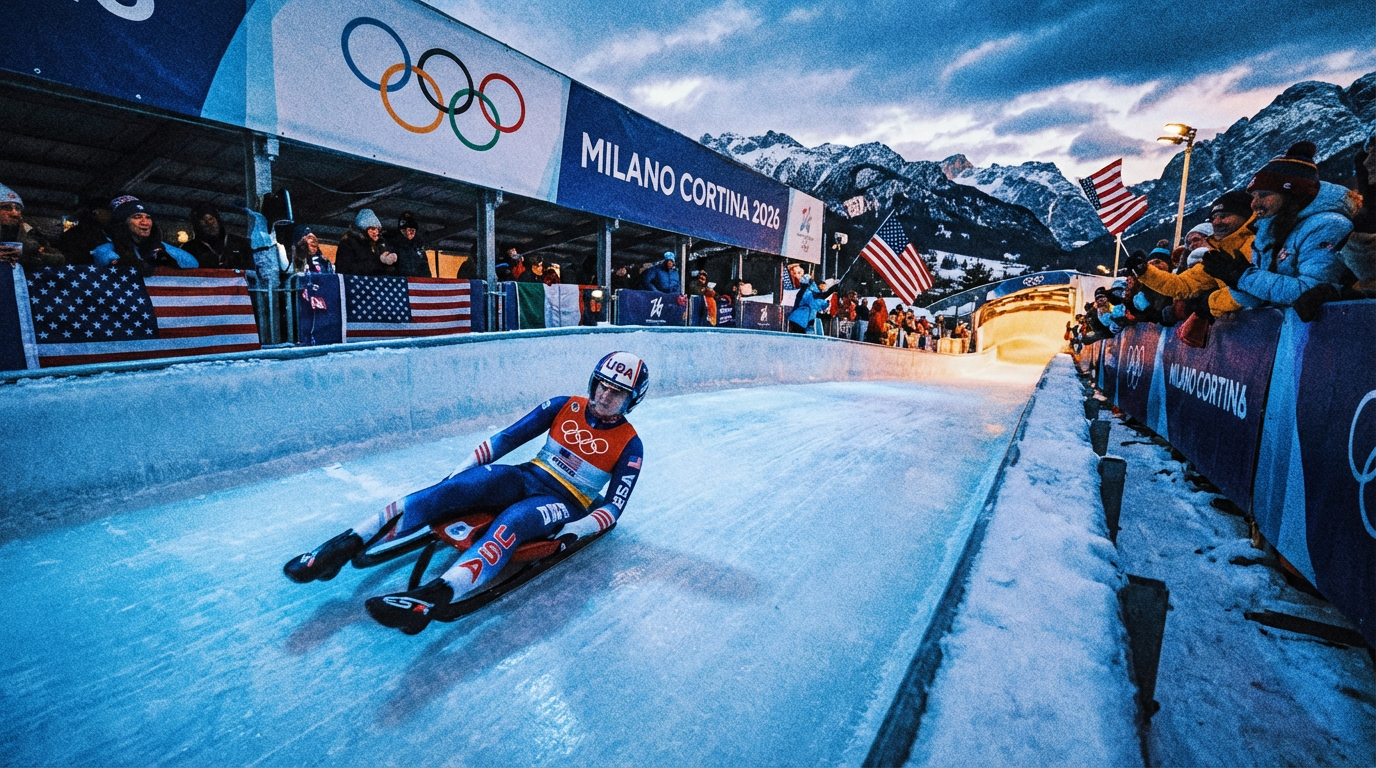
Under the floodlights of the Cortina d'Ampezzo sliding track, carved into the savage flanks of the Italian Dolomites, Ashley Farquharson hurtled toward history at 92 miles per hour. Her body, a blade of pure American grit, sliced through the frozen darkness, G-forces pinning her helmet to the ice mere millimeters below. One twitch, one doubt, and the steel runners would betray her. But Farquharson, the unlikeliest hero from tiny Roundup, Montana—a town of 1,700 where winter meant shoveling coal dust off pickup trucks—felt only fire. At 24, she crossed the finish line first, claiming gold in the women's luge singles, etching Team USA's name deeper into the 2026 Milano Cortina legend with a flawless final run of 51.128 seconds.
This wasn't just a medal. It was defiance. Luge demands surrender to terror: lying supine on a 50-pound sled, rocketing blind through 16 hairpin turns over a kilometer of iced concrete, where speeds eclipse those of a NASCAR sprint and crashes crumple carbon fiber like tinfoil. Farquharson transformed that abyss into her arena, proving that excellence blooms where fear suffocates lesser souls.
The Spark in Big Sky Country
Roundup sits in Montana's unforgiving Musselshell Valley, 100 miles from the nearest ski hill. Ashley grew up racing dirt bikes across sagebrush flats, her father, a roughneck oil driller, teaching her to lean into corners at the edge of control. Snow was scarce, but speed was her birthright. At 14, a traveling luge clinic rolled into Billings—150 miles away, a full-day haul in her family's rusted Ford F-150. She strapped into a junior sled for the first time, feeling the ice grip like a vice.
"That first push," Farquharson recalls, her voice steady as she sits post-race in the U.S. Olympic Committee's Dolomites chalet, "it was like the world cracked open. Your heart slams against your ribs, wind rips your cheeks raw, and every curve tests if you're alive or not. I was hooked. Terrified, but hooked."
By 16, she was training at the Utah Olympic Park in Park City, the cradle of U.S. sliding sports. Away from Roundup's endless horizons, she endured 6 a.m. weight sessions—deadlifts that built legs like pistons—then hours dissecting video of German and Latvian dominators. Her coach, veteran Jim Shea (grandson of the 1932 gold medalist), saw raw potential: explosive starts clocking 2.45 seconds in the first 20 meters, a match for the men.
The Brutal Ballet of Luge
Luge is physics weaponized. Riders explode from a 50-meter start ramp, paddling with spiked gloves to hit 28 mph before gravity seizes control. Then comes the plummet: 1,200 meters of banked turns, where precise weight shifts—shoulder dips, hip nudges—steer 90 kg of sled and human through chicanes steeper than a bobsled push. Air resistance is the enemy; even a helmet seam out of line costs tenths. Crashes? They launch athletes into padded walls at 80 mph, spines compressing like accordions.
Farquharson's edge lay in line mastery. She favored an aggressive inside path on high-G turns, shaving hundredths by threading needles others deemed impossible. Data from her LIDAR-equipped sled revealed micro-adjustments: a 0.3-degree toe angle on Turn 9, the Cortina "Devil's Elbow," where rivals braked instinctively.
- Start Power: Her 150-pound frame generated 1.7 g-forces off the blocks, fastest among women.
- Mid-Track Speed: Averaged 87 mph through straights, peaking at 92.4 on the Milano Cortina drop.
- Finish Control: Braked with surgical precision, minimizing spray to preserve ice grip.
Forged in Fire: The Road to Milano Cortina
Farquharson's ascent was no fairy tale. A 2023 crash at Lake Placid shattered her fibula, sidelining her for eight months. Doubts crept in—whispers from scouts that her small-town fire lacked the polish of European factories. She rebuilt in isolation, logging 400 track days yearly, visualizing every curve on a simulator that mimicked the Dolomites' 143-meter vertical drop.
World Cups became her proving ground. In 2025, she stole bronze in Sigulda, Latvia, outdueling the field with a daring line through "The Maze." By Lillehammer, she was top-five consistent. Shea drilled mental reps: "Fear is fuel, Ash. Channel it." Her mantra, scrawled on her sled: "No Fear."
"Luge strips you bare," Farquharson says. "No team to hide behind, no second chances. It's you against the ice, the speed, yourself. Winning means loving the monster inside the machine."
Olympic Glory in the Dolomites
Milano Cortina's Tesero track, reborn for 2026 amid the UNESCO-protected peaks, was a beast: 1,617 meters with 15 turns, including the "Olympic Dive"—a 180-degree helix where G's hit 4.8. Nations like Germany and Austria arrived with dynasties; Team USA sought upset.
Farquharson qualified third after four runs, her starts impeccable despite bib draw penalties. Semifinals ramped tension: trailing Germany's Lisa Schulte by 0.142 seconds entering the final pairing. The Dolomite wind howled, icing up the chutes. Farquharson watched Schulte launch—flawless start, but a slight steer error in Turn 7 cost 0.08 seconds.
Ashley's turn. She dug spikes deep, rocketed to 28.3 mph entry. Through the Dive, she held the apex line, runners singing against frost. Mid-track telemetry flashed: gaining 0.05, 0.07. The Devil's Elbow loomed—Schulte's kryptonite. Farquharson dipped left shoulder a hair earlier, apexing tighter, emerging with daylight.
Final straight: 92 mph, body arched like a bowstring. She telemarked the brake—minimal, perfect. Clock stopped: 50.892. Schulte's total: 51.034. Gold. The crowd—American flags waving amid Italian pines—erupted. Farquharson leaped from her sled, helmet raised, tears freezing on her cheeks.
Shea enveloped her: "You owned that track, kid. Pure poetry."
Legacy Beyond the Podium
Farquharson's triumph fueled Team USA's 33-medal haul, a Winter Olympics record blending brawn and brains. From Roundup's dust to Dolomite dominance, she embodied the unyielding pursuit that defines champions. Not louder cheers for stars-and-stripes, but reverence for the craft: dissecting data, defying limits, delivering under lights-out pressure.
Post-gold, she mentors juniors at Park City, her sled now museum-bound. "Fear never leaves," she confides. "You just ride faster." In a sport that devours the timid, Ashley Farquharson roared longest—proof that from America's heartland comes the thunder to shake mountains.
Word count: 1,048