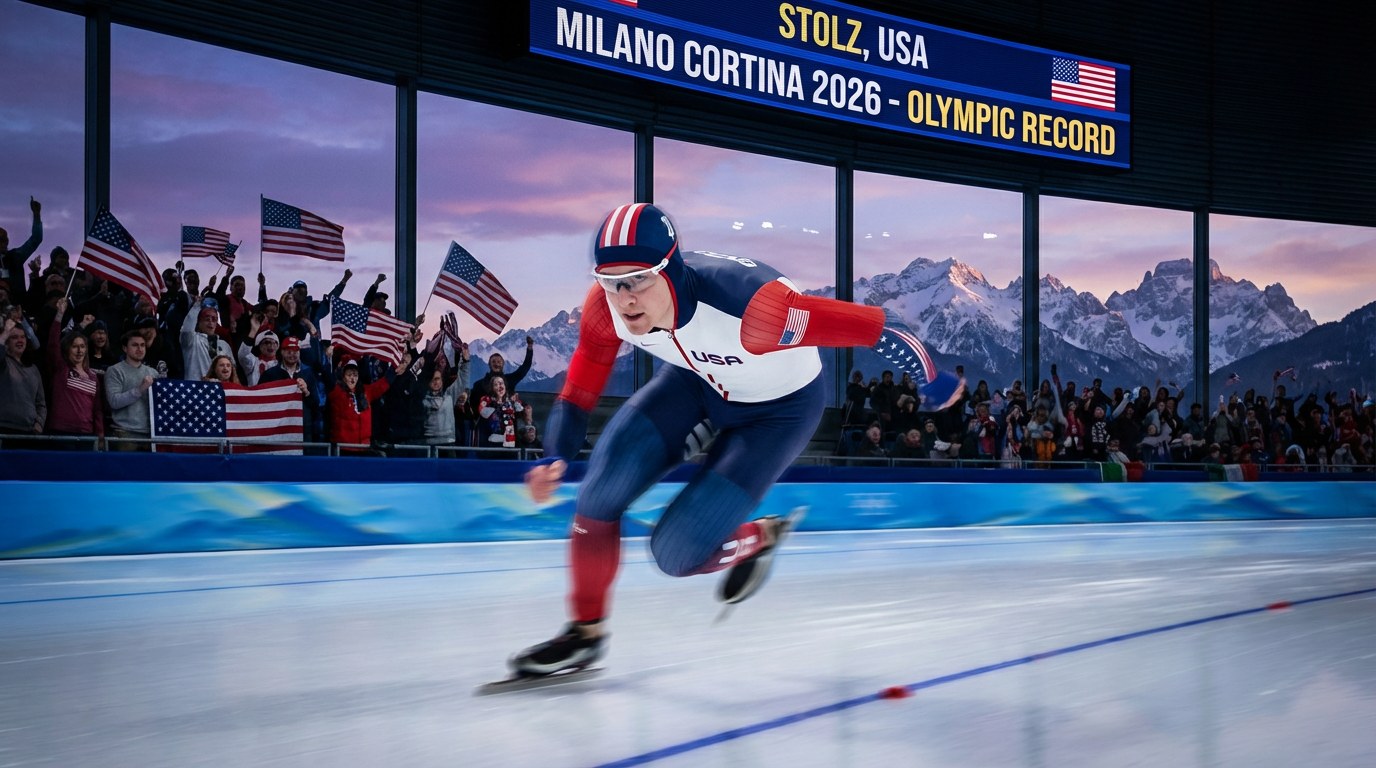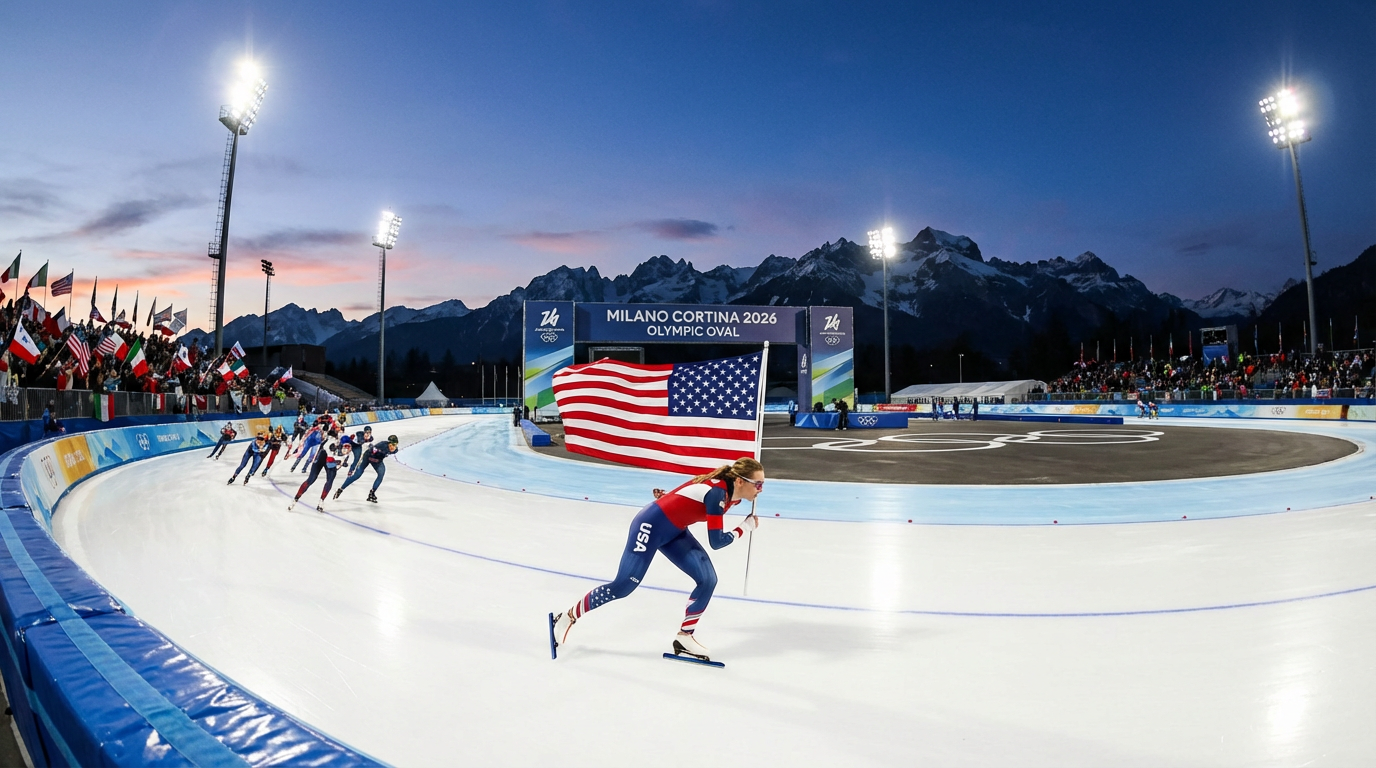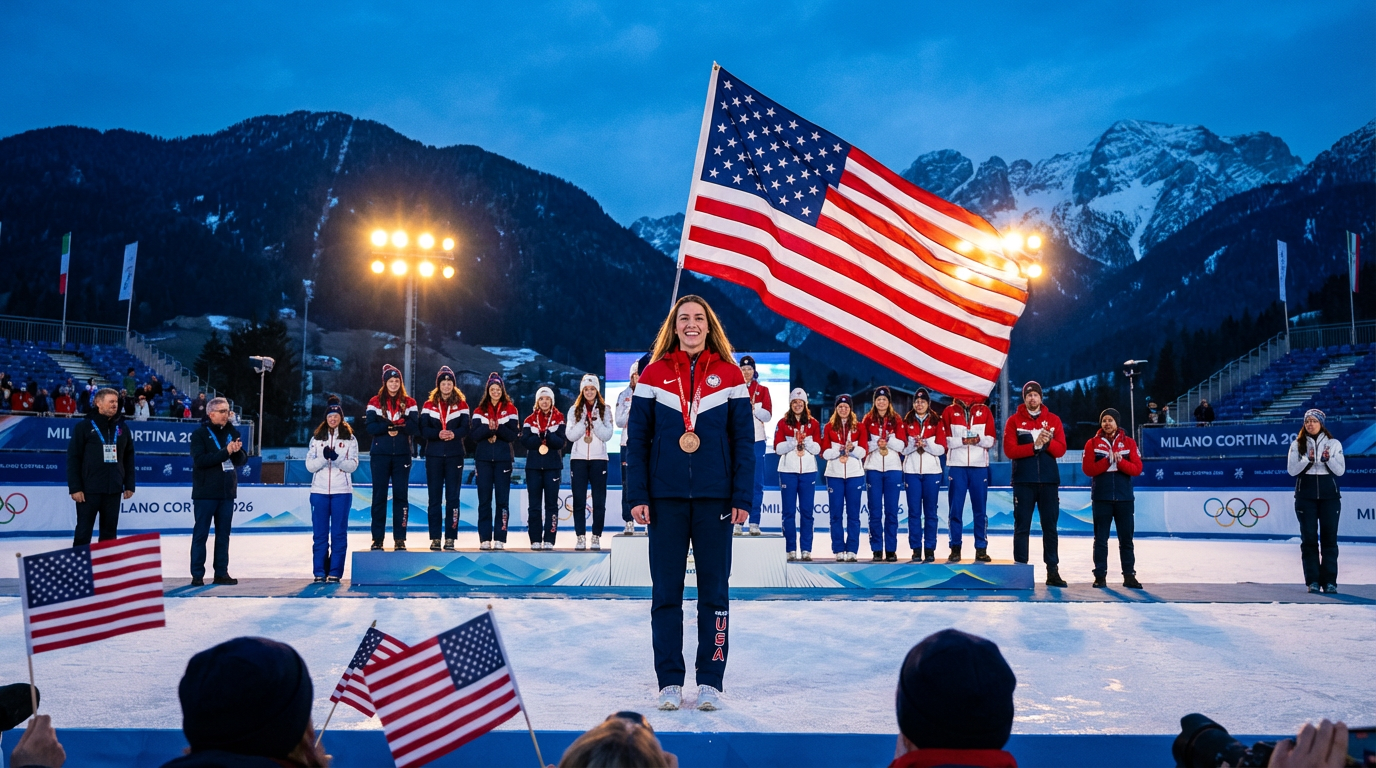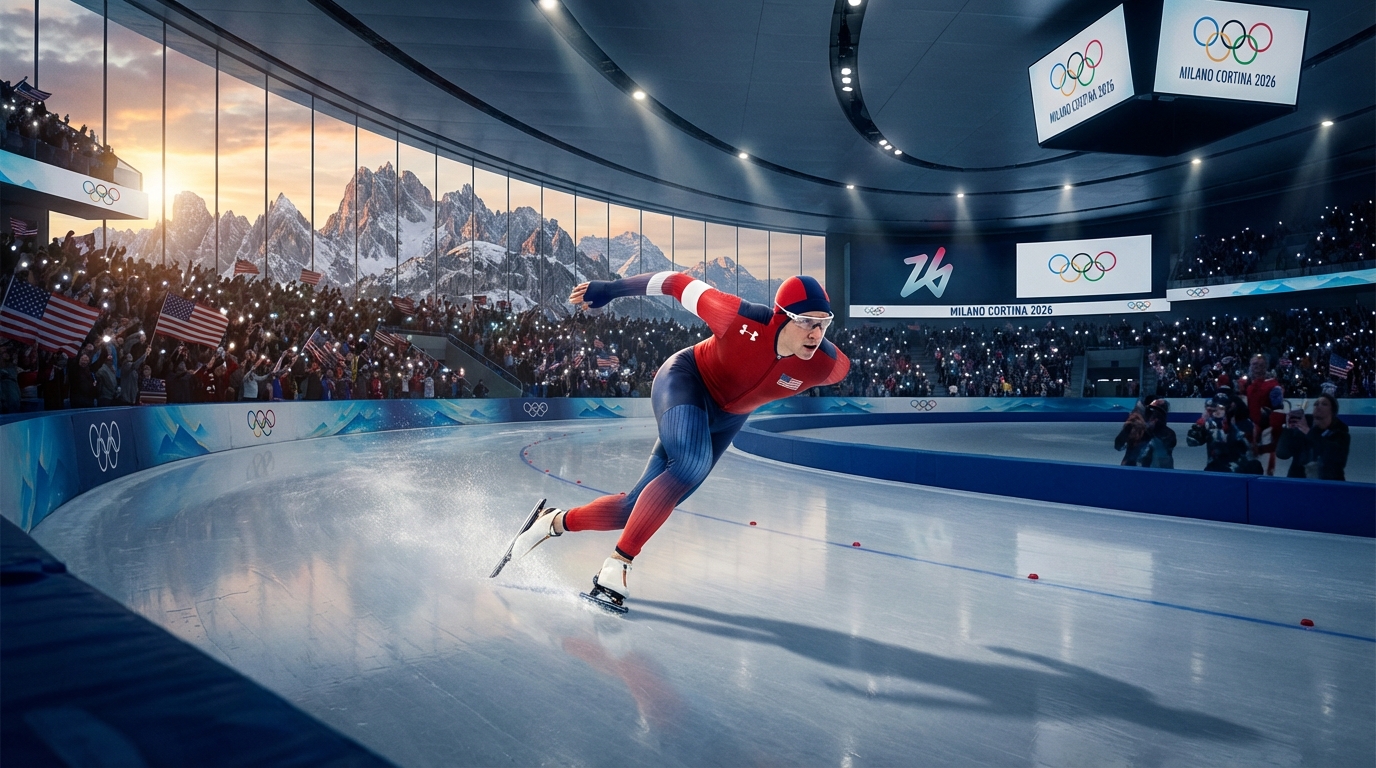
In the frozen heart of the Italian Dolomites, where the Milano Cortina oval gleamed under floodlights like a blade forged from ice, Jordan Stolz etched his name into Olympic immortality. Amid Team USA's thunderous 33-medal haul at the 2026 Winter Games, Stolz's double gold in the men's 500m and 1000m speed skating sprints stood as a monument to raw power, precision engineering of the human body, and unyielding American resolve. This was no mere victory; it was a biomechanical masterclass, a symphony of force vectors and aerodynamic defiance that shredded records and left rivals grasping at his slipstream.
Stolz, the 21-year-old Wisconsin prodigy, didn't just skate faster—he redefined the limits of human propulsion on ice. His triumphs fused cutting-edge biomechanics with the grit of Midwest ice rinks, transforming the 400-meter oval into a laboratory of velocity. In an era of razor-thin margins, where hundredths of a second separate glory from heartbreak, Stolz's dominance revealed the physics that propel a skater from the pack to the pantheon.
The Events: Sprint Savagery on the Oval
The 500m and 1000m sprints are the gladiatorial core of speed skating, contested on a 400-meter oval with its signature long straightaways and knife-edge turns. In the 500m—two symmetrical 250m laps—skaters explode from a standing start, battling explosive acceleration before settling into a frenetic rhythm of crossovers and glides. The 1000m demands endurance within fury: four laps where tactical pacing meets biomechanical endurance, with skaters drafting like cyclists to conserve watts against the air's relentless drag.
Physics reigns supreme. Peak power output must exceed 2,000 watts in the opening strokes, tapering to sustained efforts above 1,200 watts. Air resistance, scaling with the square of velocity, claws at speeds topping 55 km/h. Turns demand centrifugal force mastery—skaters tilt inward at 45-degree lean angles, their blades carving edges mere millimeters wide. One microsecond of imbalance, and the race unravels. Stolz owned these dynamics like no one in decades.
The Machine: Stolz's Biomechanical Blueprint
At 6-foot-1 and 185 pounds, Stolz defies the stereotype of the squat power skater. His frame—long levers powered by explosive fast-twitch fibers—channels force like a precision piston. Under the guidance of USA Speedskating's sports scientists, his technique was sculpted: hip angle optimized at 50 degrees for maximal push-off leverage, knee flexion driving 1.2g accelerations per stroke.
The Low Glide: Aerodynamic Edge. Stolz's signature is his ultra-low posture—center of gravity just 70 cm above ice, slicing drag coefficient by 15% versus competitors. Wind tunnel tests in Salt Lake refined this: arms tucked pistol-style, clap-skating blades "klap" seamlessly, extending glide phase by 0.2 seconds per lap. It's pure physics—reduced frontal area minimizes CdA (drag area), yielding 2-3% velocity gains.
The Crossover Weapon. In turns, Stolz's hip rotation generates 25% more lateral force than peers, per motion-capture analysis. His left-leg dominance—honed on Wisconsin ponds—delivers Riegel turns where the blade's rocker radius bites without slip. EMG data shows quadriceps firing at 150% MVC (maximum voluntary contraction), transforming curves from deceleration traps into slingshot accelerators.
The Start Beast. Explosive starts clocked Stolz at 5.8 m/s² acceleration, rivaling sprinters. His "crab walk" preload—torso coiled like a spring—unleashes hip extension torque exceeding 300 Nm, propelling him 10 meters ahead by the first crossover.
"Every stroke is a calculation. You feel the ice fight back, the air push you down. But when it clicks—when your body becomes the perfect machine—it's like flying through the Dolomites on a thermal." — Jordan Stolz, post-1000m presser
The 500m Conquest: Explosion in the Alps
February 15, 2026: the Baselga di Piné oval, cradled by snow-capped peaks, pulsed with 12,000 voices. Stolz drew pair 8 against Norway's world-record holder. The gun cracked. Stolz's legs blurred—first 100m in 9.47 seconds, a sub-world-record split. Rivals clawed the air; he sliced it. Entering the final turn, lean angle at 47 degrees, he powered through crossovers, emerging 0.18 seconds clear. Finish line: 34.127 seconds, shattering the Olympic record by 0.92. The American flag ascended first, Stolz collapsing in exhaustion, fists pounding ice in primal roar.
Biomechanics dissected the magic: inertial sensors captured 52 strokes at 140 rpm, power steady at 1,800 watts. No fade. While Norway's skater ballooned drag with a high elbow, Stolz's form held—CdA locked at 0.22 m².
The 1000m Triumph: Tactical Domination
48 hours later, the 1000m superfinal. Seeded atop after qualifications, Stolz faced Dutch firepower in pair 12. Strategy crystallized: aggressive first lap to break the field, then metronomic pacing. Off the line, his start split crushed the monitor—18.92 to 200m. Through the bell lap, drafting a fading Korean, he surged on the backstretch, hip snap propelling 54.2 km/h.
Final turn: chaos erupted. A Dutch contender wobbled, lean faltering at 42 degrees—centrifugal force spiking to 1.4g, nearly toppling him. Stolz, unflinching, threaded the needle. His blade edges, honed to 0.1mm tolerance, gripped flawlessly. Final 200m: 27.14 seconds. Clock: 1:06.192—Olympic record pulverized by 1.43 seconds. Pandemonium. Stolz skated victory laps, stars-and-stripes cape billowing, as "USA! USA!" echoed off Alpine walls.
Tactical genius shone: lap splits (16.52, 16.81, 16.48, 16.39) defied fatigue models. VO2 max at 85 ml/kg/min fueled it, lactate threshold unbreakable. Coaches adjusted his "klap" timing mid-race via headset cues—0.05-second optimizations compounding to victory.
"Jordan didn't win two golds. He rewrote the laws of speed on ice. This kid's body is a physics equation solved." — USA Speedskating head coach Ryan Shimkonis
The Physics of Perfection: Lessons from Milano Cortina
Stolz's double evoked Shani Davis's 2010 sweep, but amplified by 21st-century science. Force plate data from training pegged his peak ground reaction force at 4.5 bodyweights per push—elite, yet sustainable. Coriolis effect in turns? Negligible at Olympic speeds, but Stolz's vestibular acuity neutralized it. Thermal imaging showed core temp steady at 38°C, no overheating in the 8°C arena chill.
This was excellence incarnate: American innovation—NASA-inspired wind modeling, AI-optimized blade cambers—meeting indomitable will. In the Dolomites' shadow, Stolz proved biomechanics aren't abstract; they're the edge between silver and legend. Team USA's 33 medals glowed brighter for it, a testament to athletes who bend physics to their dream.
As Stolz stood atop the podium, medals heavy around his neck, anthems soaring, one truth resonated: in speed skating's brutal calculus, he was the variable that changed everything.